Job Translation: Federal Human Resources
How Your Corporate HR Experience Translates to Government Roles
If you're an HR professional considering a move to federal service, you're probably wondering: where do I fit? The good news is that nearly every HR function you're familiar with exists in government. The challenge is understanding how federal HR roles are structured, what they're called, and how your private sector experience translates.
Let's decode federal HR careers and show you exactly where you belong.
Understanding Federal HR: Two Main Career Tracks
Federal HR roles are organized into two distinct job series, each serving different functions:
0201: Human Resources Management
Think of these as your HR Business Partners, Specialists, and Managers. These are strategic HR professionals who design programs, advise leadership, and own entire HR functions. Entry-level positions start at GS-7/9 and execute programs, while senior roles at GS-12 and above develop policy and lead organizational HR strategy.
0203: Human Resources Assistant
These are your HR Coordinators, Assistants, and entry-level support roles, typically at GS-4/7. These positions support HR specialists by processing transactions, handling administrative tasks, and providing frontline customer service. You don't need deep expertise in HR systems for these roles, just solid administrative skills and strong attention to detail.
The key distinction: 0201 roles are strategic and advisory, while 0203 roles are transactional and support-focused. With experience and demonstrated knowledge, HR Assistants can transition into HR Manager/Specialist roles.
Your Career Path: From Entry-Level to Executive
Federal HR offers a clear progression path with increasing responsibility and strategic influence at each level:
- Starting Point (GS-4/7): Entry-level specialists execute HR programs and learn federal systems. This is where you'll build foundational knowledge of federal HR regulations and processes.
- Mid-Career (GS-9/11/12): Specialists independently manage HR functional areas, advise management on complex issues, and may lead small teams or projects. Most professionals spend several years at these levels building deep expertise.
- Senior Level (GS-13/14): HR Managers or Supervisors lead programs, develop agency-wide policies, serve as subject matter experts, and provide strategic HR guidance to senior leadership. You may supervise teams of specialists at this level.
- Executive (GS-15/SES): HR Directors and Chief Human Capital Officers shape agency-wide HR strategy, lead large organizations, and influence government-wide HR policy.
Federal Human Resources Job Specialties
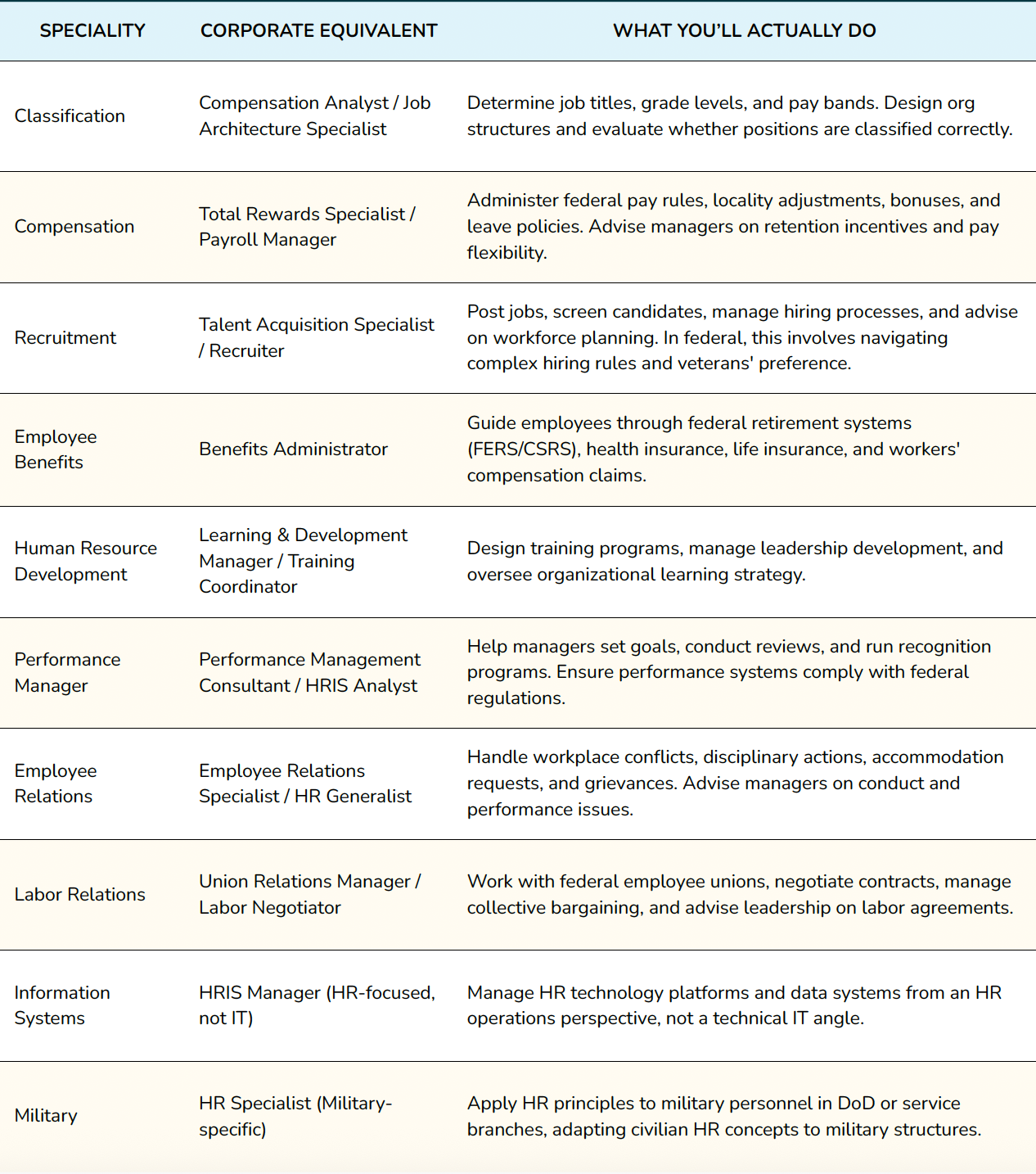
Translatable Skills
Federal HR has evolved from purely transactional compliance work to strategic advisory services that help agencies accomplish their missions while maintaining merit system principles. To succeed, you'll need:
- Communication Skills: Speaking, active listening, and written communication are essential. You'll constantly explain policies, advise management, and interact with employees at all levels.
- Critical Thinking & Problem Solving: These roles require analyzing complex situations, identifying compliance issues, and developing solutions within regulatory constraints.
- Attention to Detail: Federal HR requires precision. Mistakes in classification, benefits administration, or labor relations can have serious legal and financial consequences.
- Interpersonal Skills: Building relationships, social perceptiveness, negotiation, and conflict resolution are used daily in federal HR work.
The Federal HR Job Market: Where the Opportunities Are
While federal hiring has seen a recent drop-off, opportunities still exist, particularly in specific sectors and locations.
While federal hiring has seen a recent drop-off, opportunities still exist across diverse agencies and locations nationwide.
You don't need to move to Washington, D.C. to build a federal HR career. In fact, opportunities are distributed across the country, with significant concentrations in unexpected places.
Texas leads with 586 open HR roles across various federal agencies and military installations. California follows closely with 564 positions spanning from San Diego to Sacramento. Colorado offers 339 roles, combining military installations with agencies like the National Park Service and federal land management offices.
It's worth noting that military branches represent a substantial portion of federal HR hiring, the Army, Air Force, and Navy combined account for about 60% of current openings. Veterans with military HR experience have a natural advantage in these roles, but civilian agencies from the Department of Veterans Affairs to the Department of Agriculture also consistently hire HR professionals.
Whether you're interested in defense, healthcare, land management, law enforcement, or any other mission area, federal HR roles exist across the country. These geographic hubs offer the chance to build a meaningful career in public service while living in communities that fit your lifestyle, no Beltway required.
Making the Transition
Federal HR work offers meaningful public service, and the opportunity to impact the lives of federal employees across the country. The key to making a successful transition is understanding how your experience translates, identifying which job series and specialty align with your background, and targeting agencies that match your interests.
Your corporate HR experience is valuable in federal service. Now you know exactly where it fits.
Ready to explore federal HR opportunities? Visit www.govskills.io to search open roles across all levels of government, or follow us on LinkedIn for the latest public sector labor market insights.